

Luca Brocca
Head of Legal Research
When a State authorises the export of military equipment, has the manufacturer fulfilled its responsibility to respect human rights?
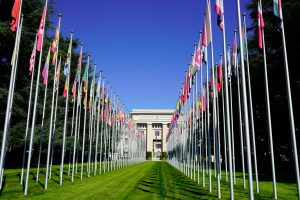
This question was at the heart of Just Access’s contribution to the 15th United Nations Forum on Business and Human Rights, held at the Palais des Nations in Geneva from the 23rd to the 25th of November 2026.
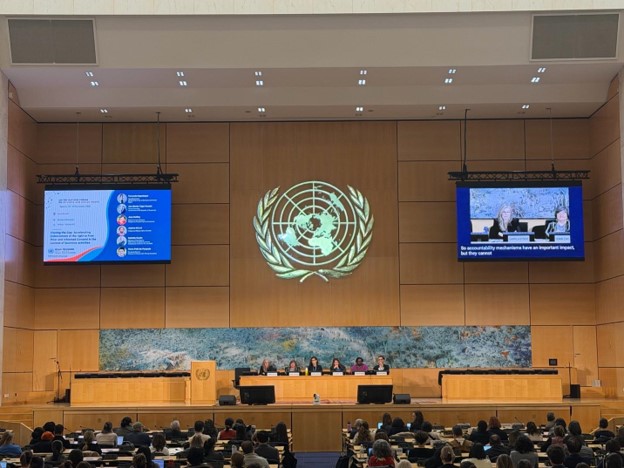
The Forum is the world’s largest annual gathering on business and human rights, with more than 3,000 participants from governments, business, civil society, trade unions, and academia. On the 23rd of November, Just Access co-organised an informal dialogue in the Assembly Hall with the Voluntary Principles Initiative, with the support of SaferGlobe: Business and Human Rights in Defence and Security: New Frontiers.
The Guiding Principles at fifteen
This year marks the fifteenth anniversary of the UN Human Rights Council’s endorsement of the UN Guiding Principles on Business and Human Rights in 2011. Under the theme “UNGPs at 15: Building on Gains, Confronting Gaps, Reimagining the Future”, the Forum reviewed both the progress made and the obstacles that remain, at a time the organisers describe as one of “interlocking crises”.
The programme addressed a range of issues, including artificial intelligence, human rights defenders and groups at risk, labour rights, critical energy transition minerals, climate change, and the role of investors. Access to effective remedy in complex environments and human rights due diligence in conflict-affected regions were among the Forum’s sub-themes.
Knowing where to go is the first step towards remedy.
New frontiers in defence and security
Moderated by Maria Mekri, Executive Director of SaferGlobe, the panel brought together Professor Anita Ramasastry, Rachel Chambers of the University of Connecticut, Gerald Pachoud of Pluto Advisory, Mora Johnson, Steven Malby of the Voluntary Principles Initiative, and Luca Brocca, Head of Legal Research at Just Access. The discussion covered issues ranging from human rights due diligence and international humanitarian law to artificial intelligence and security in the extractive sector.
Across the interventions, a common thread emerged: in the defence and security sector, compliance with export licences and regulations is the starting point of corporate responsibility. Interactive audience polls encouraged broader participation. One asked participants to imagine they had survived an unlawful attack on civilians and filmed the armoured vehicle involved: who would they send the video to first? Most were unsure. Many chose the media, and some chose NGOs. Few pointed to the company that made the vehicle until the discussion highlighted its role, even though it is the actor that could stop further supplies.
What happens after the licence?
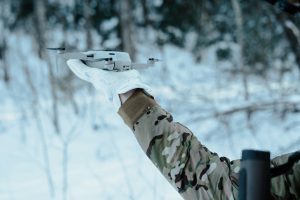
Luca Brocca’s intervention focused on arms diversion. In 2022, the UN Working Group on Business and Human Rights clarified that the Guiding Principles apply to defence companies across their downstream value chain. An export licence shows that a State has authorised a transfer. It does not show that the company has met its own responsibility to respect human rights.
An export licence shows that a State has authorised a transfer. It does not show that the company has met its own responsibility.
Arms diversion illustrates the practical significance of this distinction. In November 2024, Amnesty International verified images of armoured vehicles used by the Rapid Support Forces in Sudan, fitted with a defence system manufactured in a third country. The component maker was several steps removed from the end user, and the evidence came from open sources rather than compliance checks.
Since September 2025, Just Access’s Sudan Project has collected testimonies from survivors of the conflict now living in refugee settlements in Uganda. The project was not designed to trace weapons, but it shows that survivors and local witnesses are often the first to see how equipment is actually used. This information rarely reaches the companies that could act on it.
Survivors and local witnesses are often the first to see how equipment is actually used.
Just Access highlighted three practical recommendations. In conflict-affected settings, heightened human rights due diligence should be ongoing and proactive. Credible testimony and open-source evidence should feed into it and prompt companies to reassess existing risks. Companies need safe channels to receive this information, run through trusted intermediaries such as NGOs. Informed consent, confidentiality, and the safety of survivors must come first, as they do in Just Access’s own work documenting testimonies. Where misuse emerges, companies should use their leverage, including by suspending supplies and, where they have contributed to harm, taking part in remedy.
Improving Access to Remedy
Identifying and navigating available accountability mechanisms remains a significant challenge for many survivors. Just Access therefore presented the Remedy Finder, a free tool designed to help users identify international complaint mechanisms relevant to their country, and Beyond the Licence, a free interactive learning game on corporate responsibility in the defence sector.
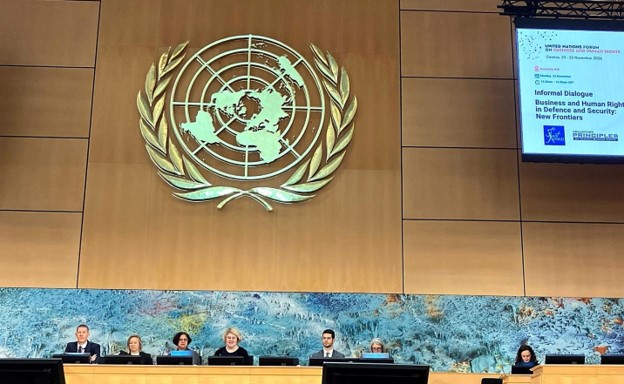
Just Access thanks the Voluntary Principles Initiative, SaferGlobe, the Forum Secretariat, and all panellists and participants. Bringing together companies, governments, international organisations, and civil society in the same room showed how much each holds a different part of the picture. Just Access will take this forward through its Sudan Project and its research on business and human rights.
Support our work!
We can only do our work thanks to the support of brave, passionate people like you!
Your donation will help us to keep fighting for human rights and access to justice for everyone, everywhere.