

Helena Jost
Legal Intern
From the moment we wake up to the time we fall asleep we are confronted with a constant stream of media coverage on conflicts happening all around the globe. But who decides what is covered and to what extend? Why do some conflicts receive constant media attention while others seem to fade into the background? And what role do narratives spread through social media play in the conflicts themselves?
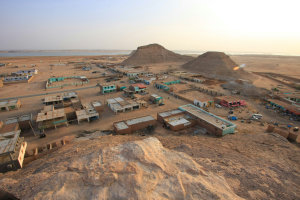
Ongoing since April 2023, one conflict that often seems to take a back seat to others is the conflict in Sudan. Unlike many other conflicts, media coverage remains to be comparatively low, which is why Just Access is committed to raising awareness for the suffering endured by the civilian population in Sudan.
As part of this effort, Just Access recently participated in the hybrid event “Understanding Information Warfare in Sudan” hosted by How to Build Up, Inc. The event clearly demonstrated how far greater attention must be paid to how social incubators spread narratives cultivated and deployed by armed actors such as the Rapid Support Forces (RSF) or the Sudan Armed Forces (SAF), to collectively punish civilian communities.
[D]eceptive narratives are constructed to portray specific communities, ethnic groups, political opponents, activists, or aid workers as supporters of “the enemy".
The “War on Dignity” Narrative
Particularly striking in this context is the “War on Dignity” narrative used by the SAF to frame whole civilian communities as RSF backers. Spread primarily through social media, this narrative portrays the conflict as a “dignity war” intended to defend the sovereignty of Sudan against foreign interference and opposing militias. In doing so, the SAF spreads misleading claims about both the motives and underlying causes of the conflict, while shifting blame onto civilian communities. The narrative conveniently obscures the fact that both forces have committed serious abuses and attacks that affected millions of civilians.
The “Narrative-to-Reprisal Pipeline”
The amplified use of such misleading narratives leads to a phenomenon known as the “narrative-to-reprisal pipeline” in which conflicts are defined by weaponized narratives and targeted reprisal. In the context of conflicts, such as the one in Sudan, deceptive narratives are constructed to portray specific communities, ethnic groups, political opponents, activists, or aid workers as supporters of “the enemy”. Forces, such as the SAF, utilize various social media channels for the coordinated distribution of disinformation, manipulated images, and hate speech to reinforce false claims.
These narratives are then used to categorise individuals or entire communities as targets. Consequently, civilians are frequently detained, assaulted, displaced, or even killed based on nothing more than a perceived allegiance to the opposing side. The narratives constructed prior to these violent actions are subsequently used to justify those acts as reprisal, framing them not as crimes, but as legitimate retaliation.
By labelling entire civilian communities as RSF supporters, turning them into targets of violence, and using these narratives as grounds for punishment even in the absence of individual criminal responsibility, the SAF violates the prohibition of collective punishment…
Why does it matter legally?
From the perspective of international humanitarian law (IHL), the use of such narratives violates both the principle of distinction and the prohibition of collective punishment. Although the conflict in Sudan is classified as a non-international armed conflict (NIAC), both principles apply as they are firmly established as rules of customary international law, binding all parties to a conflict regardless of its classification.
This customary status is confirmed by the ICRC’s Customary IHL Study (Rule 1 on distinction and Rule 103 on collective punishment), and the prohibition of collective punishment is further reflected in Common Article 3 of the Geneva Convention and Article 4 (2) (b) of Additional Protocol II.
The principle of distinction requires that in the case of armed conflict, combatants and civilians must be distinguished from one another at all times. Since civilians do not directly participate in hostilities, they may not be attacked under any circumstances. Furthermore, it is prohibited to convict anyone of an offense in the absence of individual criminal responsibility.
By labelling entire civilian communities as RSF supporters, turning them into targets of violence, and using these narratives as grounds for punishment even in the absence of individual criminal responsibility, the SAF violates the prohibition of collective punishment, thereby causing immense suffering among Sudan’s civilian population. These narratives thus construct a pretextual basis for acts that are categorically prohibited under IHL.
With a definitive legal framework protecting civilians regardless of the type of conflict, the question becomes why are the actions by the violent perpetrators in Sudan and other places met with impunity? Why has the conflict gone on for years with civilians suffering the most egregious harms while the international legal community fails to meet its obligations?
Check out Part II of this post to learn the answers to these questions and what can be done about it.
Support our work!
We can only do our work thanks to the support of brave, passionate people like you!
Your donation will help us to keep fighting for human rights and access to justice for everyone, everywhere.